Employee Health Insurance in Kenya: Real 2026 Costs

Last year, a friend's startup lost their best developer.
Not to a competitor.
To a company offering health insurance.
Same salary. Better benefits.
That's how competitive hiring has become in Kenya.
And if you're running a business without group health insurance, you're already behind.

Table of Contents
- What Is Corporate Health Insurance?
- Group Cover Isn't Only for Employers
- Is Corporate Health Insurance Mandatory in Kenya?
- How Much Does Corporate Health Insurance Cost?
- What Does Corporate Health Insurance Cover?
- Who Gets Covered?
- How Insurers Price a Group
- Do Employees Need Medical Exams?
- Benefits for Your Business
- How to Choose the Right Corporate Health Insurance Plan
- Best Corporate Health Insurance Providers in Kenya
- How to Set Up Corporate Health Insurance (Step-by-Step)
- Premium Payment Options
- Adding New Employees
- Handling Employee Exits
- Annual Renewal: What to Expect
- What If Claims Are High?
- Tax Benefits Explained
- Common Mistakes Businesses Make
- How to Communicate Benefits to Employees
- Should You Cover Dependents?
- Alternative: Employee Contribution Plans
- What About SHA (Social Health Authority)?
- For Agents: Selling Group Cover to SMEs
- Next Steps for Your Business
What Is Corporate Health Insurance?
Simple definition:
Group health insurance for your employees.
Instead of each employee buying individual insurance, you buy one policy that covers everyone.
Benefits:
- 30-40% cheaper per person than individual policies
- Better coverage
- Easier administration
- Tax deductible for your business
- Attracts and retains talent
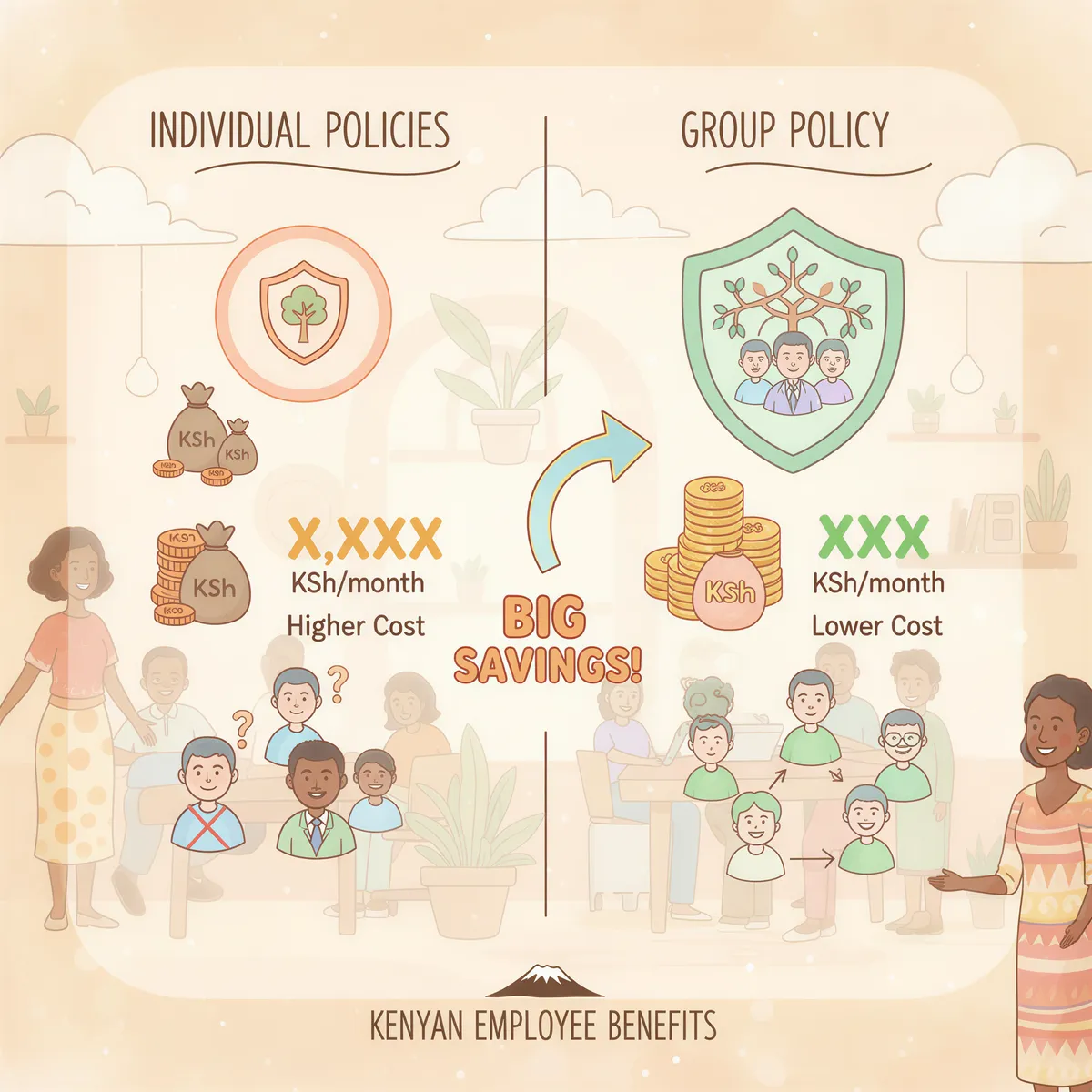
Group Cover Isn't Only for Employers
Three ways a group gets covered:
1. Employer-sponsored. The company buys one policy for its staff. It pays all of the premium, or splits it with employees. Best for businesses, NGOs and schools.
2. Voluntary groups. Chamas, SACCOs, professional associations, alumni groups. Members pool together, the group negotiates, each member pays their share.
3. Affinity schemes. A large association negotiates a rate. Members opt in individually and pay their own premiums.
Same idea every time: one negotiation, many people covered.
Is Corporate Health Insurance Mandatory in Kenya?
No. But...
The Employment Act (2007) doesn't mandate health insurance.
However:
- It's becoming a standard expectation in formal employment
- Helps you comply with Occupational Safety and Health Act (OSHA) requirements
- Shows you care about employee welfare
Bottom line: Not legally required. But competitively necessary.
How Much Does Corporate Health Insurance Cost?
Real numbers for Kenyan SMEs (2026):
Small Business (5-10 Employees)
Inpatient only:
- KES 15,000 - 20,000 per employee/year
- Total: KES 75,000 - 200,000/year
Inpatient + Outpatient:
- KES 30,000 - 40,000 per employee/year
- Total: KES 150,000 - 400,000/year
Medium Business (11-50 Employees)
Inpatient only:
- KES 12,000 - 18,000 per employee/year
- Total: KES 132,000 - 900,000/year
Inpatient + Outpatient:
- KES 25,000 - 35,000 per employee/year
- Total: KES 275,000 - 1,750,000/year
Larger Business (51-100 Employees)
Inpatient only:
- KES 10,000 - 15,000 per employee/year
- Total: KES 510,000 - 1,500,000/year
Inpatient + Outpatient:
- KES 22,000 - 30,000 per employee/year
- Total: KES 1,122,000 - 3,000,000/year
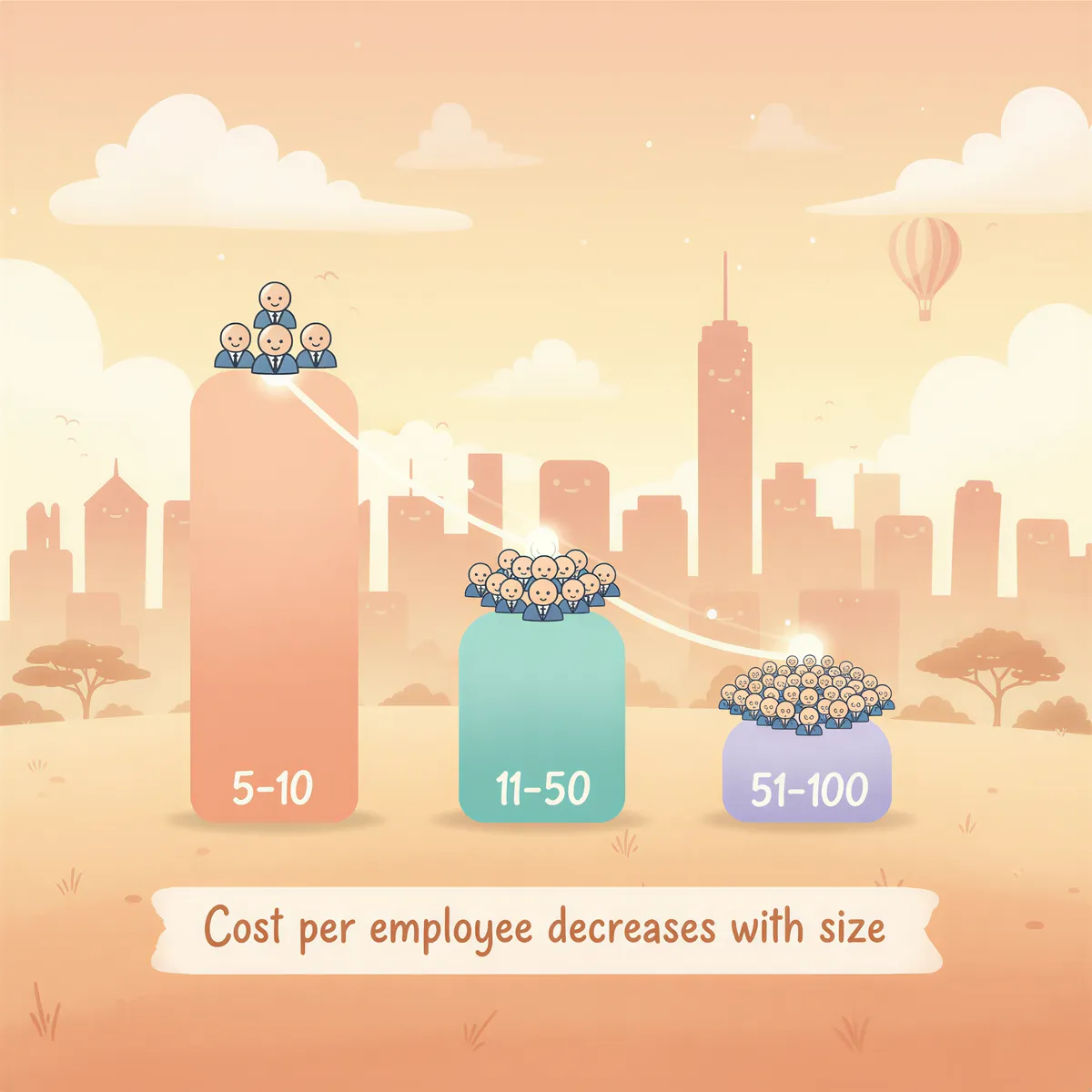
The rule: More employees = lower cost per person (economies of scale).
What Does Corporate Health Insurance Cover?
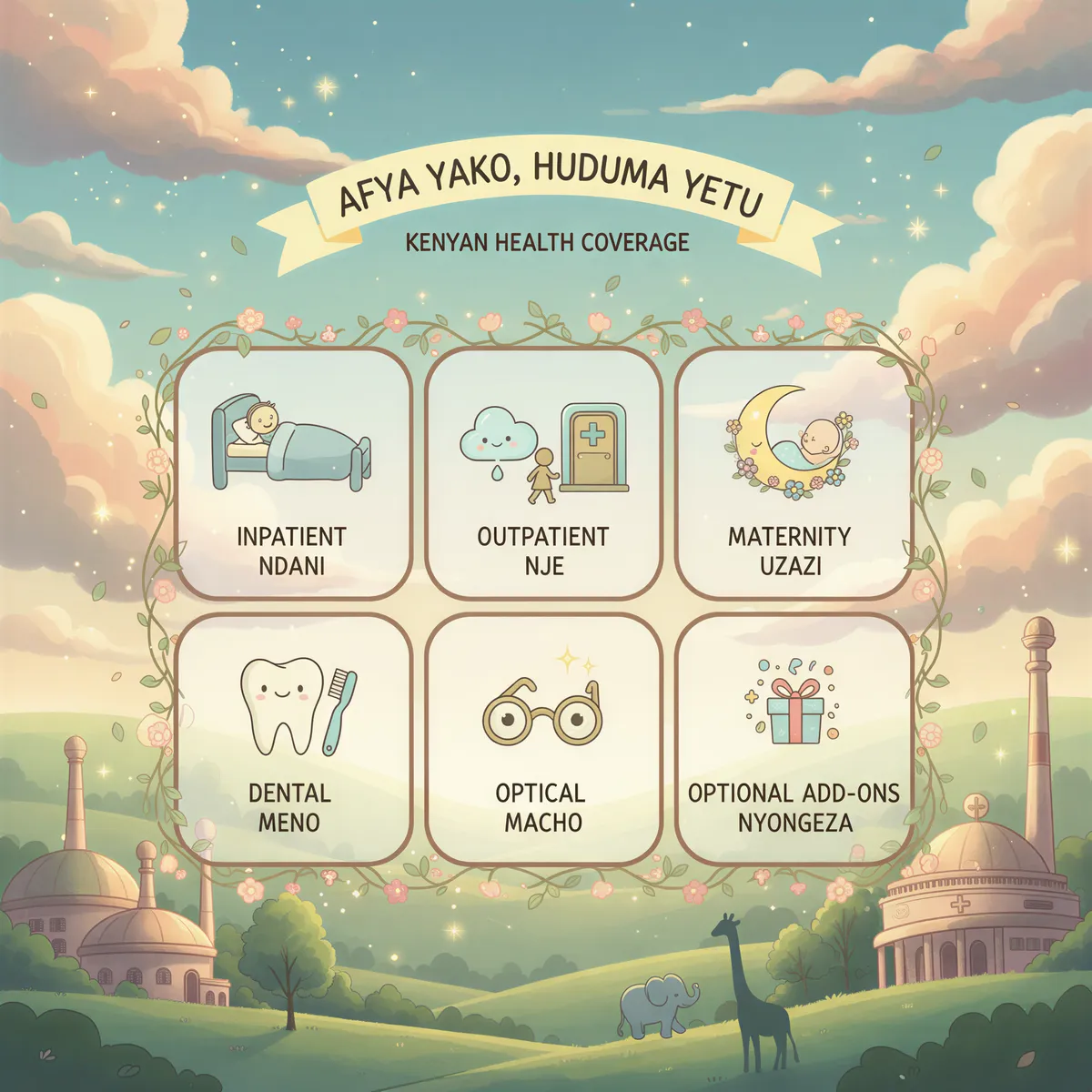
Standard packages include:
Inpatient Cover
✔ Hospital admission ✔ Surgery and procedures ✔ ICU/HDU care ✔ Medication during admission ✔ Specialist consultations ✔ Diagnostic tests (while admitted)
Outpatient Cover (Optional but Recommended)
✔ Doctor visits ✔ Lab tests and X-rays ✔ Prescriptions ✔ Specialist referrals ✔ Physiotherapy
Maternity Cover (Optional)
✔ Pre-natal checkups ✔ Delivery (normal or C-section) ✔ Post-natal care ✔ Newborn cover (first 90 days)
Dental & Optical (Optional)
✔ Dental checkups, fillings, extractions ✔ Eye tests, glasses, contact lenses
Additional Benefits (Premium Plans)
✔ Last expense (burial) cover ✔ Personal accident cover ✔ International emergency medical evacuation ✔ Chronic disease management
Who Gets Covered?
Standard corporate policy covers:
- All permanent employees
- Employee's spouse (optional, at extra cost)
- Employee's children (up to 4 kids, optional)
- New hires (added within 30 days of joining)
Not usually covered:
- Contract workers (unless specified)
- Interns (unless specified)
- Casual laborers
- Consultants
How Insurers Price a Group
Five things move the number:
- Group size. More lives usually means a lower rate per person.
- Age profile. A young team is cheaper than an older one.
- Cover. Inpatient only, or inpatient plus outpatient, maternity, dental and optical.
- Hospital panel. Premium hospitals cost more.
- Claims history. At renewal, a high-claims year pushes the price up.
Send the insurer an accurate age list. A vague headcount gets you a vague quote.
Do Employees Need Medical Exams?
Usually not, and that's a big part of the appeal.
Small groups are more likely to be asked for medical questionnaires. Larger groups are often covered without individual underwriting.
Pre-existing conditions are commonly covered after a waiting period. The exact rules vary by insurer and group size, so get them in writing before you sign.
Benefits for Your Business
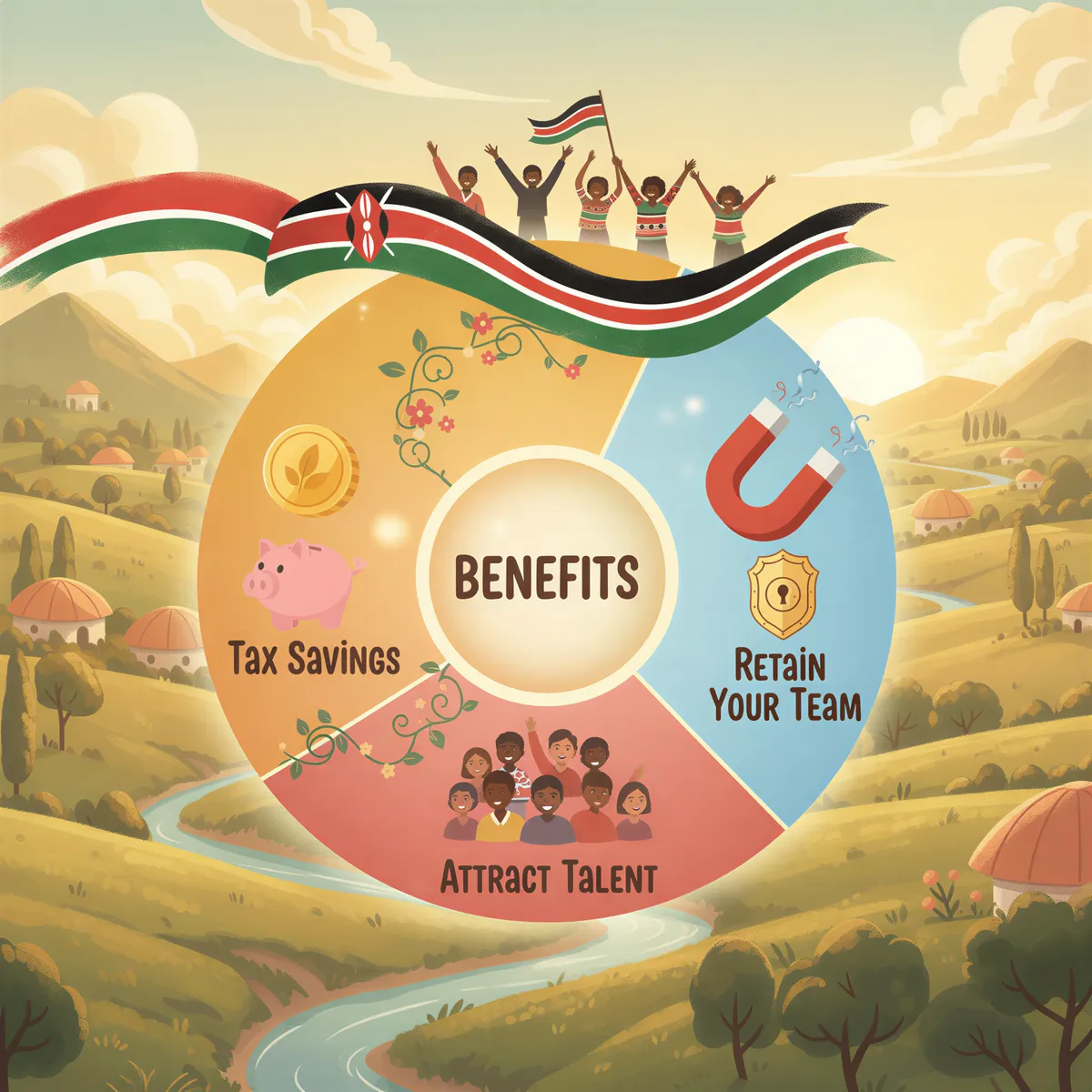
1. Tax Deductible Health insurance premiums are 100% tax deductible as a business expense.
Example:
- Annual premium: KES 500,000
- Corporate tax rate: 30%
- Tax savings: KES 150,000
Real cost to your business: KES 350,000.
2. Attract Better Talent Top candidates prioritize benefits.
Job posting with health insurance > job posting without.
3. Reduce Absenteeism Healthy employees = fewer sick days.
Studies show insured employees take 25-40% fewer sick days.
4. Boost Employee Morale Employees who feel cared for work harder.
Simple as that.
5. Retain Your Team It costs 3-5x more to hire a replacement than to keep an employee.
Health insurance is retention insurance.
How to Choose the Right Corporate Health Insurance Plan
Ask yourself these questions:
Question 1: What's Your Budget?
Be realistic. Don't over-stretch.
Rule of thumb: Budget 3-5% of total payroll for health insurance.
Question 2: What Do Your Employees Need?
Survey them.
Ask:
- Preferred hospitals?
- Need outpatient?
- Maternity cover necessary?
- Dental/optical important?
Question 3: Inpatient Only or Full Package?
Inpatient only: Cheaper, covers emergencies Full package: More expensive, covers everything
For office workers, inpatient + outpatient is standard.
Question 4: Cover Dependents?
Covering spouses and kids costs 40-60% more per employee.
But it's a massive retention tool.
Question 5: What Hospital Network?
Check if major hospitals are included:
- Nairobi Hospital
- Aga Khan Hospital
- MP Shah Hospital
- Mater Hospital
- Kenyatta Hospital
Best Corporate Health Insurance Providers in Kenya
Based on network, claims, and value:
1. AAR Insurance
Best for: Large companies (50+ employees) Network: 500+ hospitals Strengths: Largest network, fast claims, excellent service Weakness: Premium pricing
2. Jubilee Health Insurance
Best for: SMEs planning growth Network: 400+ hospitals Strengths: Great maternity cover, competitive pricing Weakness: Slower pre-authorization
3. Britam Health
Best for: Budget-conscious businesses Network: 300+ hospitals Strengths: Affordable, growing network Weakness: Smaller network than AAR/Jubilee
4. CIC Insurance
Best for: Businesses wanting bundled insurance (health + other) Network: 350+ hospitals Strengths: Bundling discounts, corporate focus Weakness: Customer service inconsistent
5. Resolution Health
Best for: Transparent, tech-savvy companies Network: 250+ hospitals Strengths: Clear pricing, excellent portal, specialist health insurer Weakness: Smaller network
How to Set Up Corporate Health Insurance (Step-by-Step)
Step 1: Get Quotes from 3-5 Insurers
Don't accept the first quote.
Submit:
- Number of employees
- Age breakdown
- Desired coverage (inpatient/outpatient/maternity)
- Preferred hospitals
Step 2: Compare Quotes
Look at:
- Cost per employee
- Coverage details
- Hospital network
- Exclusions
- Claim process
Step 3: Negotiate
Everything is negotiable:
- Premium rates
- Payment terms
- Renewal conditions
- Waiting periods
Insurers want corporate clients. Use that leverage.
Step 4: Get Board/Management Approval
Present:
- Cost-benefit analysis
- Tax savings
- Employee retention benefits
Step 5: Provide Employee Data
Submit to chosen insurer:
- Full names
- ID numbers
- Dates of birth
- Dependent details (if applicable)
Step 6: Sign the Policy
Review terms carefully.
Check:
- Coverage start date
- Renewal date
- Premium payment schedule
- Claim procedures
Step 7: Distribute Insurance Cards
Employees get:
- Physical insurance cards
- Digital cards (app/portal access)
- Summary of benefits
Step 8: Conduct Employee Orientation
Explain:
- What's covered
- How to use the insurance
- Claim process
- Approved hospitals
Timeline: 2-4 weeks from start to coverage activation.
Premium Payment Options
Most insurers offer:
Option 1: Annual Payment
Pros:
- 5-10% discount
- One payment, done
Cons:
- Big cash outlay
Option 2: Semi-Annual
Pros:
- Smaller payments
- Still get 3-5% discount
Cons:
- Two payments to manage
Option 3: Quarterly
Pros:
- Easier cash flow management
- Minimal discount (2-3%)
Cons:
- Four payments/year
Option 4: Monthly
Pros:
- Best for cash flow
- Spread the cost
Cons:
- No discount
- 12 payments to track
Most SMEs choose quarterly or semi-annual.
Adding New Employees
Within first 30 days of employment: Free addition. No medical underwriting.
After 30 days: May require:
- Medical questionnaire
- Possible waiting periods for pre-existing conditions
- Additional premium
Pro tip: Add employees immediately upon hiring.
Handling Employee Exits
When an employee leaves:
- Notify insurer within 30 days
- Stop their coverage
- Get pro-rated refund (if applicable)
Can the employee convert to individual cover?
Some insurers offer continuation options:
- Employee buys individual policy (at higher rate)
- No waiting periods
- Maintains coverage continuity
Ask about this when choosing an insurer.
Annual Renewal: What to Expect
Renewal happens every 12 months.
What changes:
-
Premium increases (expect 10-20% annually)
- Based on claims history
- Age of workforce
- Medical inflation
-
Coverage adjustments (if needed)
- Add/remove benefits
- Change hospital network
-
Employee updates
- Add new hires
- Remove exits
- Update dependents
Renewal timeline: Insurer contacts you 60 days before expiry.
Negotiation tip: Get competing quotes during renewal. Use them as leverage.
What If Claims Are High?
High claims = higher renewal premiums.
Strategies to manage:
Strategy 1: Wellness Programs
Prevent illness through:
- Annual health screenings
- Gym memberships
- Mental health support
- Nutrition education
Healthier employees = fewer claims = lower premiums.
Strategy 2: Introduce Co-Payments
Employees pay 10-20% of claims.
Reduces frivolous usage. Lowers premiums by 15-25%.
Strategy 3: Increase Deductibles
Company pays first KES 5,000-10,000 of each claim.
Lowers premiums by 10-15%.
Strategy 4: Switch Insurers
If renewals are unreasonable, shop around.
Tax Benefits Explained
Corporate health insurance is 100% tax deductible.
How it works:
Example:
- Annual revenue: KES 10,000,000
- Payroll: KES 4,000,000
- Health insurance premium: KES 600,000
- Other expenses: KES 3,000,000
Taxable income calculation:
- Revenue: KES 10,000,000
- Less: Payroll (KES 4,000,000)
- Less: Insurance (KES 600,000)
- Less: Other expenses (KES 3,000,000)
- Taxable income: KES 2,400,000
Tax savings:
- Without insurance deduction: KES 900,000 tax (30% of KES 3,000,000)
- With insurance deduction: KES 720,000 tax (30% of KES 2,400,000)
- Savings: KES 180,000
Real cost of insurance: KES 420,000 (KES 600,000 - KES 180,000 tax savings)
Common Mistakes Businesses Make
Mistake 1: Choosing Cheapest Option Low premium often = limited network + high co-payments.
Mistake 2: Not Covering Outpatient Employees end up paying out of pocket for doctor visits. Defeats the purpose.
Mistake 3: Forgetting About Renewals Policies lapse. Employees lose coverage. Bad for morale.
Mistake 4: Not Communicating Benefits Employees don't know what they have. Can't appreciate it.
Mistake 5: No Wellness Program High claims year after year = skyrocketing premiums.
How to Communicate Benefits to Employees
Don't just hand out cards.
Do this:
Step 1: Benefits Orientation
- Host a 30-minute session
- Explain coverage
- Show how to use insurance
- Answer questions
Step 2: Provide Summary Booklet
- Simple, 2-page summary
- What's covered
- Approved hospitals
- Emergency contacts
Step 3: Regular Reminders
- Quarterly emails
- Claim submission tips
- Wellness program updates
Step 4: Celebrate the Benefit
- "Your company cares" messaging
- Share how insurance helped employees
Make employees feel the value.
Should You Cover Dependents?
Pros:
- Massive retention tool
- Employees feel truly cared for
- Competitive advantage
Cons:
- Increases cost by 40-60% per employee
- More admin work
When it makes sense:
- You can afford it
- You're competing for top talent
- Employee retention is critical
When to skip:
- Tight budget
- High employee turnover
- Most employees are young/single
Alternative: Employee Contribution Plans
Can't afford to pay 100%?
Try a shared cost model:
Option 1: 70/30 Split
- Company pays 70%
- Employee pays 30%
Option 2: Tiered Contribution
- Company pays 100% for employee
- Employee pays 50% for dependents
Option 3: Cafeteria Plan
- Company provides basic inpatient
- Employees can upgrade (at their cost)
Still better than no insurance.
What About SHA (Social Health Authority)?
SHA is mandatory.
All employees contribute 2.75% of gross salary.
But SHA only covers:
- Public hospitals
- Basic care
- Shared wards
Private insurance covers:
- Private hospitals
- Fast service
- Private rooms
- Specialist care
Bottom line: SHA is the base. Private insurance is the upgrade.
Offer both. Employees need both.
For Agents: Selling Group Cover to SMEs
SMEs are the sweet spot. Big enough to need group cover. Small enough that the owner decides.
What Owners Actually Mean
| They say | They mean |
|---|---|
| "Is it affordable?" | Will this hurt cash flow? |
| "We struggle to keep good people" | Benefits might help retention |
| "Staff are often off sick" | Healthier staff, more output |
| "We don't have HR" | Don't make my life harder |
Ask Before You Quote
- How many staff, and roughly what ages?
- Do you offer any health benefit today?
- What's your biggest staff retention problem?
- What budget do you have in mind for benefits?
- Who signs off on this?
Then Propose Two or Three Options
One option is a yes/no question. Three is a choice.
A simple spread: inpatient only, inpatient plus outpatient, and the full package with maternity. Let the owner pick.
Don't Disappear After the Sale
Run the staff orientation. Help with the first claims. Show up before renewal with a claims summary and competing quotes.
That's how a one-off sale becomes a client who renews, and refers.
Next Steps for Your Business
- Determine your budget (3-5% of payroll)
- Survey employees (what do they need?)
- Get 3-5 quotes from different insurers
- Compare coverage and costs
- Negotiate terms
- Get management approval
- Set up the policy
- Communicate benefits to employees
Health insurance isn't just a benefit.
It's an investment in your team.
And teams that feel valued?
They stick around.
Start Generating Quotes in Minutes
Compare quotes from Kenya's leading insurers and send a client a proposal in under a minute.
No credit card required.
Get quotes from 40+ underwriters in under 30 seconds.
All quotes meet Insurance Regulatory Authority standards.
Never miss a commission payment with automatic tracking.